
Skip to product information



Prusament PC Space Grade Black 850g (NFC)
£229.00
Please note this item has a delivery of 5 to 10 working days
About PC Space Grade Black
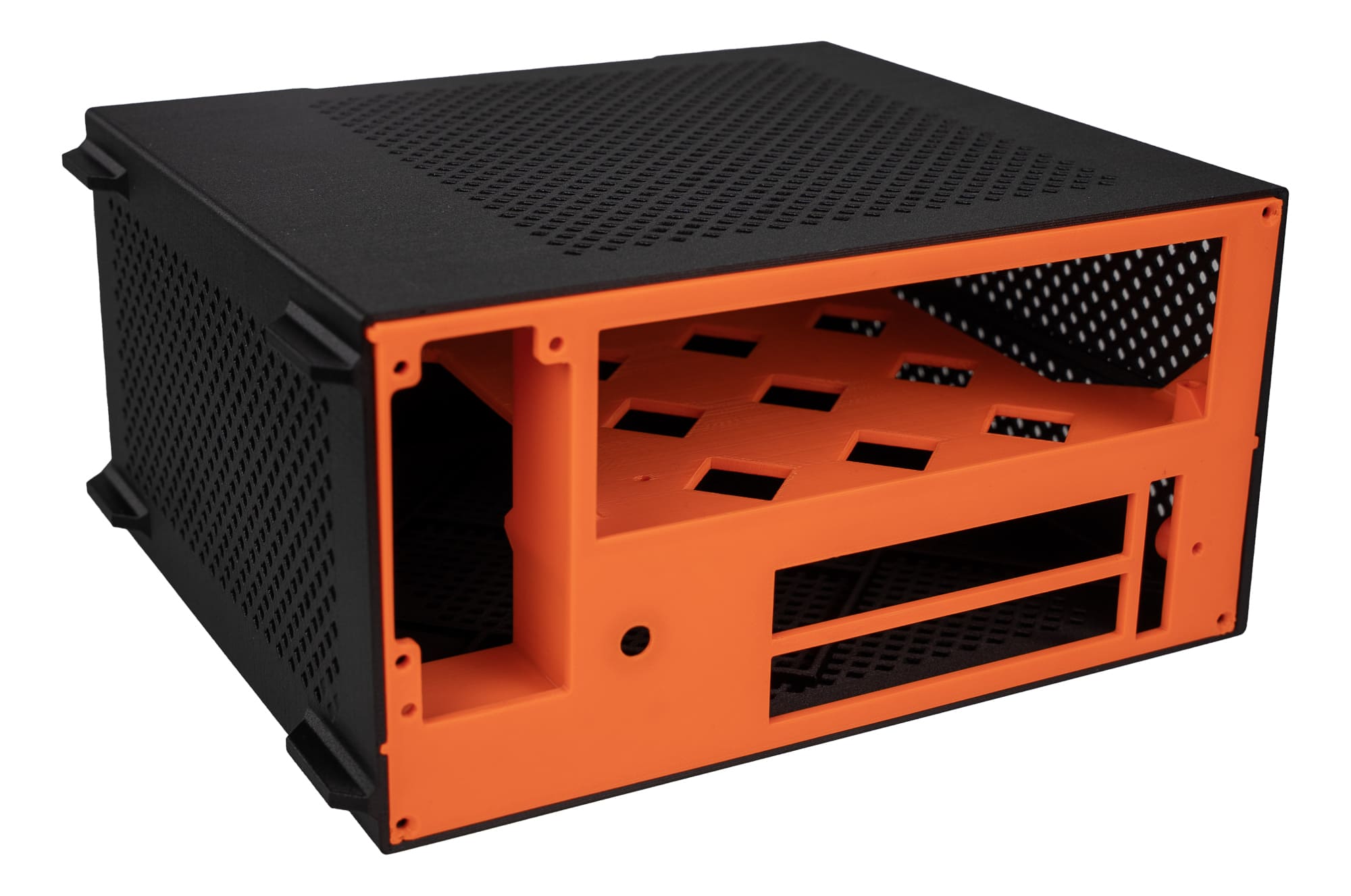
Prusament PC Space Grade Black is a material developed for the space industry and particle physics applications. Its main advantages are its ESD-safe properties and very low outgassing. Plus, its affordable price and ease of printing on common desktop printers make it something unique in this industry. Due to its excellent ESD properties and compatibility with desktop 3D printers, it’s suitable not only for parts exposed to outer space but also for advanced personal projects, such as housings for electronic devices and more.
High-end material accessible to everyone
Prusas goal was to create a professional, yet affordable material that would make prototyping and manufacturing space components easier. Until now, only costly materials like PEEK, PEKK and PEI with ESD-safe properties were suitable in this field. All of these materials require highly expensive industrial printers. Prusament PC Space Grade Black can be printed on most Prusa 3D printers, which significantly reduces the final price of manufactured components and greatly increases accessibility for everyone.
 Electrostatic dissipation properties (ESD)
One of the main characteristics necessary for use in space components is electrostatic dissipation. This quality is important not only for space engineers but also for anyone who works with electronic devices. In hobby use, the ESD-safe materials can be used for making custom PC cases and similar products.
The measured resistance of dissipative materials ranges between 104 and 1011 Ohms. Ohms. Anything with higher resistance is considered insulating and anything with lower values is considered a conductive material.
Prusa measured both the volume and surface resistivity of 3D printed samples from Prusament PC Space Grade Black, and the results confirmed the highly dissipative nature of the material. The volume resistivity was measured at 2.2×10 4 Ω⋅m, while the surface resistivity was 6×10⁷ Ω/sq. These exceptional values were obtained directly from the 3D printed samples, without any post-processing, such as annealing or sanding, which is a testament to the filament's inherent and consistent ESD performance. This demonstrates that parts can be printed and immediately put into use for a wide range of applications requiring reliable electrostatic dissipation.
Outgassing
Various residual monomers or products of polymer degradation are released from the polymers under vacuum. This can affect, or even damage, the electronics used on the satellite (or any other precise machinery). Released gases can contaminate optical devices or cause inaccurate measurements of precise sensors. Finally, the gas release itself can decrease the material’s physical and mechanical properties. Manufacturing thermoplastic polymers with low outgassing levels is a great challenge, and it is usually achieved in expensive industrial-grade materials, such as PEKK and PEEK. We were able to fulfil strict requirements defined by the European Space Agency using PC (polycarbonate), which is a relatively cheap, common, and easy-to-print material.
Measured outgassing values:
TML (Total Mass Loss): The mass loss is represented as a percentage. The ESA limit is 1%; Prusament PC Space Grade Black achieved 0.25%.
CVCM (Collected Volatile Condensable Material): The limit stated by ESA is less than 0.1 %; the Prusament PC Space Grade Black reached a perfect 0.00 %.
RML (Recovered Mass Loss): The maximum limit stated by ESA is 1.0 %; the Prusament PC Space Grade Black reached 0.12 %.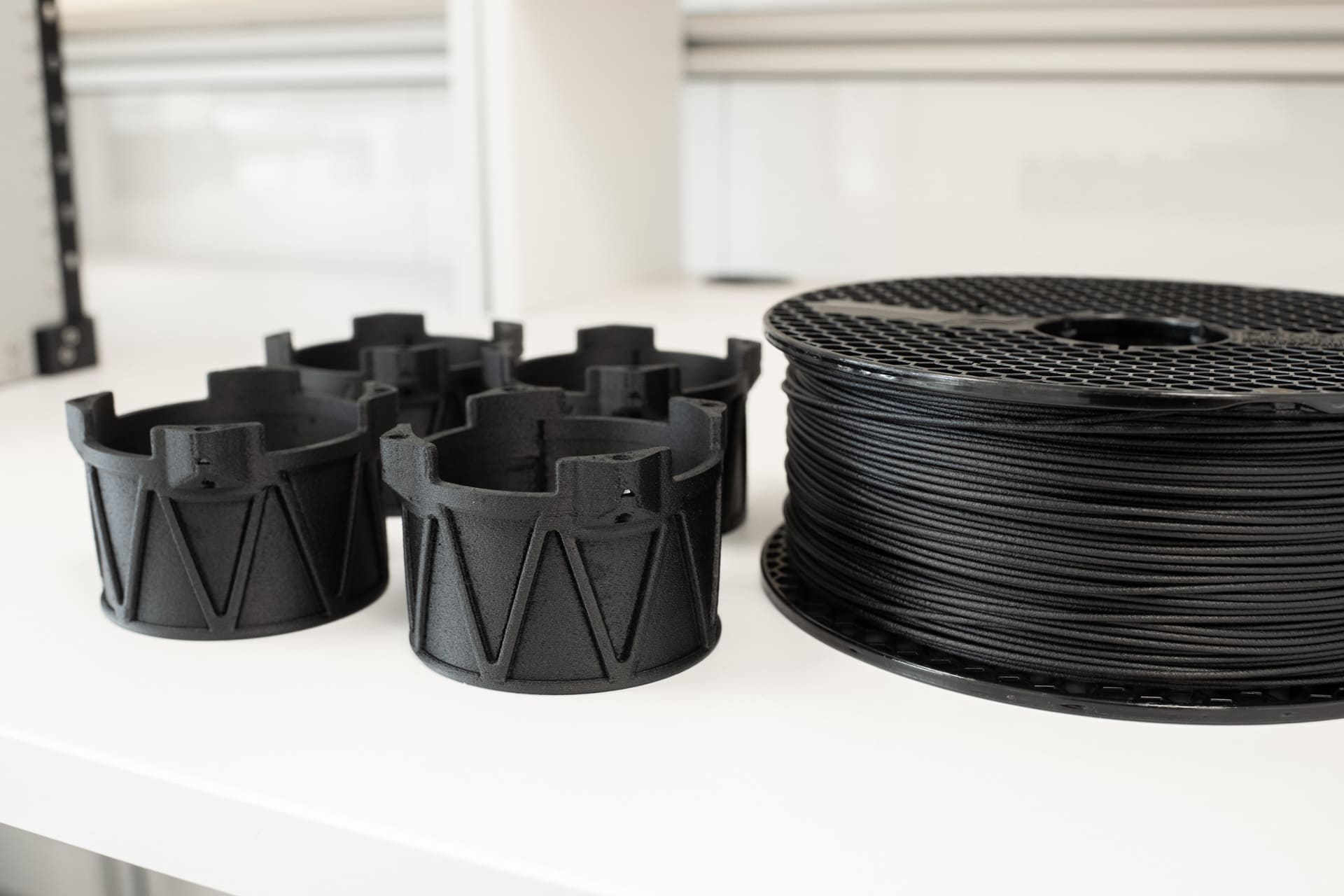
Mechanical properties
At the beginning of our joint project with TRL Space, Prusa conducted a Finite Element Method simulation for a single-unit CubeSat design and established the minimal required values for mechanical properties that 3D printed parts should exceed. These minimal values were 70 MPa for tensile strength, 2 GPa for tensile modulus, 10 MPa for interlayer adhesion and 100 °C for heat deflection temperature (HDT).
Prusament PC Space Grade Black successfully surpassed these criteria Prusa reached:
- Tensile strength: 75 MPa
- Tensile modulus: 3.7 GPa
- Interlayer adhesion: 18 MPa
- HDT: 137.6 °C at 0.45 MPa load
Exceeding these values (together with outgassing and ESD properties) makes the filament a strong candidate as an affordable material suitable for future CubeSat production.
 Printing Setup
Prusament PC Space Grade Black can be printed on common desktop 3D printers, just like regular polycarbonates. The filament shows little to no warping. Models as large as 200x200 mm can be safely printed on Prusa 3D printers without any issues.
Supported 3D printer profiles: Prusa Core One, MK4S, XL, Prusa Pro HT90 (3rd party 3D printers may be used as well)
| Nozzle | 290±10 °C |
| Heatbed | 120±10 °C |
| Recommended Steel Sheet | Textured / Satin / PP |
| Enclosure | Not necessary |
Drying filament: We recommend drying the filament before printing (4-6 h at 90 °C) and keeping it in a drybox during the print for the best results. Dry Prusament PC Space Grade Black offers exceptional dimensional accuracy and the best mechanical and outgassing properties.
Basic Attributes
+ ESD-safe material
+ Excellent outgassing propertiesGreat high-temperature resistance (up to 137.6 °C)
+ Great dimensional stability – possible to print large models without an enclosure
+Can be printed on common desktop 3D printers
- Requires a hardened nozzle
- Lower layer-to-layer adhesion compared to pure PC
- May require drying before printing
Prusament PC Space Grade Black is made in-house by Prusa Research.
1.75 mm filament is manufactured with a precision of ±0.04 mm.
We do not guarantee a perfect winding for this type of filament.
prusament-pc-space-grade-black-technical-data-sheet_1